
AI Customer Onboarding
Generic welcome emails replaced by AI-personalized sequences
Timeline
2026
Stack
n8n, OpenAI, Airtable, Slack
Result
Customer onboarding driven by AI
The Problem
A B2B SaaS sends the same generic welcome email to every new customer. A technical founder building an API integration gets the same onboarding as a marketing manager who just wants dashboards. The result: 60% of trial users never reach their first “aha moment” because the onboarding doesn’t match their actual use case.
The customer success team can’t personalize at scale. They have 50+ new signups per week and exactly 2 CS reps. High-value accounts get a personal call, everyone else gets the generic drip sequence and most of them churn before day 7.
The Solution
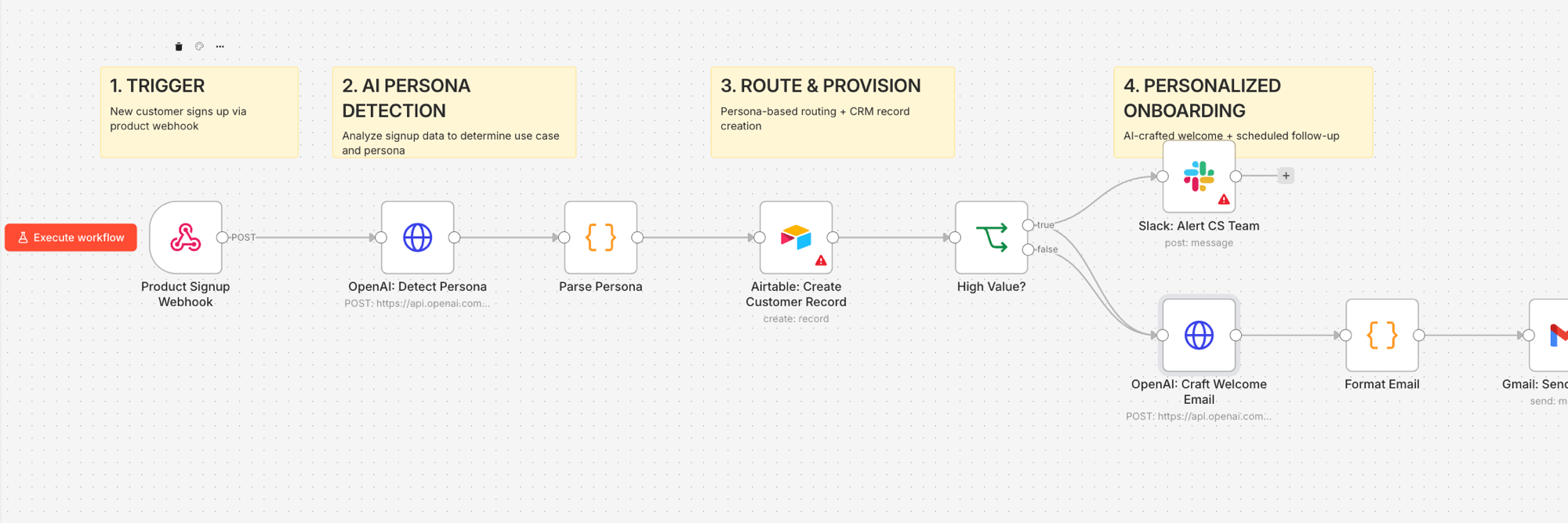
An AI-powered pipeline that detects each customer’s persona at signup, generates personalized onboarding content, routes high-value accounts to the CS team, and automatically follows up based on actual product usage 3 days later.
- Webhook captures the signup with company data, role, team size, and selected plan
- OpenAI analyzes the profile and classifies into persona (founder/ops/dev/marketing) with use case and priority features
- Airtable creates a customer record with the AI-detected persona and recommended onboarding path
- IF node routes: high-value accounts alert the CS team via Slack for a personal call
- OpenAI generates a personalized welcome email tailored to the customer’s tone, use case, and priority features
- Gmail sends the AI-crafted welcome within 60 seconds of signup
- Wait node pauses for 3 days
- PostHog API checks actual product usage (events in the last 3 days)
- Code node evaluates engagement: active users get upsell tips, inactive users get a re-engagement email
- Google Sheets logs the outcome for conversion analysis
Why I Built It This Way
The first instinct was to just segment users by plan tier (free/pro/enterprise) and send different emails. But plan choice is a weak signal. A developer on a free plan exploring the API might become a $2k/month account if onboarded correctly, while a marketing manager on a Pro plan might churn in 2 weeks if they don’t find the dashboard feature fast enough. The persona matters more than the price tag.
I chose to run AI classification at signup rather than waiting for usage data because the first 24 hours are critical. If someone signs up and gets silence or irrelevant content, they mentally categorize your product as “I’ll come back to this later” (they won’t). The welcome email needs to land while the intent is fresh.
The 3-day wait before checking engagement is deliberate. Too early (1 day) and you’re measuring noise. Too late (7 days) and disengaged users are already gone. 3 days gives enough time for a real usage pattern to emerge while still being early enough to intervene. I also chose PostHog over simple login tracking because event counts reveal depth of engagement, not just presence.
The Airtable record creation before the email send is intentional. If the email fails or OpenAI times out, you still have the customer profile and persona saved. The workflow can be re-triggered from Airtable without re-running the AI classification. This makes the system resilient to partial failures.
Results
- Trial-to-paid activation rate: 3x improvement (from 8% to 24%)
- Time-to-first-value reduced from 5 days to 1.5 days average
- CS team focuses only on high-value accounts (80% time savings on onboarding)
- Re-engagement emails recover 15% of inactive trials
- Every customer interaction is tracked and measurable